Vietnam needs not only to export higher cargo volumes, but also to build a seaport and logistics network capable of moving Vietnamese goods to international markets more efficiently. In this context, the growing partnership between Vietnam Maritime Corporation (VIMC) and Mediterranean Shipping Company (MSC) has drawn considerable attention across the maritime sector.
In early October 2026, a series of notable developments unfolded in rapid succession: accelerating the Can Gio International Transshipment Port project, high-level discussions on expanding investment in Vietnam, and launching the Pearl service connecting Hai Phong directly with the US market. These milestones demonstrate that bilateral cooperation extends well beyond seaport infrastructure plans into live freight operations and actual cargo connectivity.
From Strategic Agreements to Tangible Progress
According to Hai Phong Port, on July 1, 2026, Hai Phong Port and Saigon Port — two member units of VIMC — signed a strategic cooperation agreement with MSC Vietnam and MEDLOG Vietnam Holding.
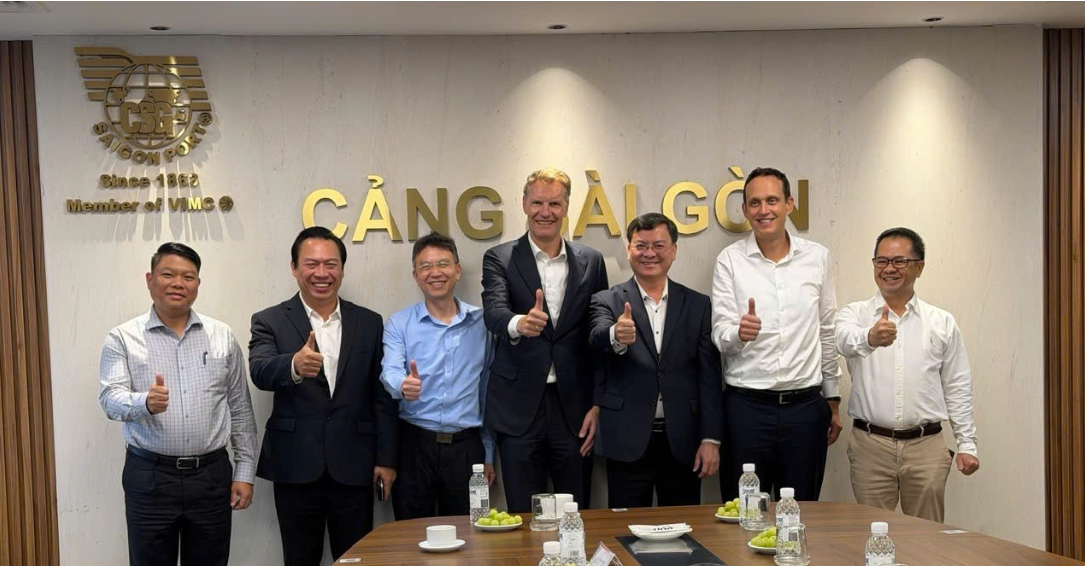
The partnership focuses on “developing and executing integrated logistics services nationwide”, while optimizing strategic seaport infrastructure such as Berths 3 and 4 at Lach Huyen in Hai Phong and the Can Gio International Transshipment Port project in Ho Chi Minh City.
This is particularly noteworthy given the intimate linkage between seaports, maritime shipping, and logistics services. A high-performing port requires steady cargo throughput; shipping lines need well-placed port networks to optimize service loops; and shippers require transport connections that balance transit times against freight costs.
When these components coordinate effectively, the resulting value goes beyond container stevedoring to seamless cargo flow from manufacturing facilities and warehouses to global consumer markets.
Can Gio: The Ambition to Build a Global Transshipment Gateway
One of the primary pillars of the partnership is the Can Gio International Transshipment Port project.
According to the Government Electronic Portal on April 14, 2026, the approved investor consortium comprises VIMC, Saigon Port, and Terminal Investment Limited Holding S.A. (TiL), an operating entity within MSC's global ecosystem.
The project spans approximately 571 hectares with an estimated total investment of nearly 128,873 billion VND (approx. 5.1 billion USD). Designed capacity is projected at 4.8 million TEUs by 2030 and 16.9 million TEUs by 2047.
This scale reflects Can Gio's positioning as a generational maritime infrastructure development, rather than merely an incremental container facility for southern Vietnam. If successfully implemented, the port will facilitate direct calls by ultra-large container vessels (ULCVs), broadening routing choices and elevating Vietnam’s strategic stature within regional logistics corridors.
Nonetheless, the project remains in planning and prerequisite completion phases rather than commercial operation. Future efficacy will hinge on construction timelines, hinterland and multimodal transport links, cargo attraction capabilities, and competitiveness against established transshipment giants such as Singapore and Malaysia.
October: Momentum Across Both Ends of the Country
According to VIMC on October 9, 2026, representatives from VIMC, Saigon Port, and MSC met on October 7 with Ho Chi Minh City municipal leaders to review Can Gio’s progress, statutory procedures, and connectivity infrastructure planning.
Discussions centered on arterial road links, inland waterways, and navigational channel depth to accommodate mega container vessels. This reinforces that port development cannot be separated from synchronized investment into surface connectivity and cargo evacuation capacity.
On October 9, during a formal reception for MSC Chief Executive Soren Toft, Permanent Deputy Prime Minister Pham Gia Tuc praised the group’s expanding investments in Vietnam. As reported by the Government Portal, Mr. Soren Toft confirmed: “Vietnam is a vital market in MSC’s global development strategy.”
This statement underscores Vietnam’s prominent role in MSC’s strategic roadmap. Nonetheless, final investment allocations and milestone schedules will require ongoing validation across forthcoming official regulatory filings and announcements.
Pearl Service at Hai Phong: Direct Connection to the US Market
While Can Gio represents long-term strategic ambition, the Pearl service out of Hai Phong delivers immediate operational impact for container shipping.
On October 9, 2026, TIL Hai Phong International Port (HTIT) welcomed the container vessel MSC SPARKLE III, inaugurating MSC’s Pearl service line, as announced by VIMC on October 12, 2026.
The service rotation covers Hai Phong – Shanghai – Ningbo – Busan – Long Beach – Oakland, linking Northern Vietnam directly with key gateways on the US West Coast, with average weekly throughput estimated at approximately 6,000 TEUs.
Launching this dedicated service provides exporters and importers with enhanced routing alternatives for transpacific trade. By bypassing intermediate transshipment hubs, appropriate shipments benefit from simplified voyages and greater scheduling reliability.
Dr. Nguyen Thi Thuy Hong, Vice Dean of the Faculty of Economics at Vietnam Maritime University, noted on VIMC’s portal that reduced transit times and eliminated feeder transfers directly “enhance operational autonomy and competitiveness” for Vietnamese exports entering the US market.
Nevertheless, a new service loop does not guarantee every consignment moves faster or cheaper. Cargo owners must still scrutinize sailing frequencies, actual transit schedules, ocean rates, bunker adjustments, and local surcharges for each specific consignment.
The True Opportunity for Vietnamese Trade: Full Supply Chain Value
Trade volumes underscore the necessity of stronger maritime links. According to the Government Portal on October 3, 2026, Vietnam’s total import-export turnover in the first nine months of 2026 reached 888.02 billion USD, up 30.4% year-on-year.
With trade flows expanding rapidly, port and maritime capabilities dictate far more than transit speed: they directly determine supply stability, inventory holding costs, production schedules, and overall landed logistics costs.
However, modern port berths alone cannot safeguard competitiveness. Ultimate trade performance depends equally on terminal productivity, customs clearance speed, inland road and waterway transport, forwarding service quality, and vessel schedule integrity.
For import-export enterprises, what matters most is not simply new project announcements or maiden vessel calls, but whether these enhancements yield additional carrier choices, reduce dwell times, and lower total logistics expenditure per shipment.
The collaboration between MSC and VIMC is noteworthy on both fronts: establishing foundational infrastructure for tomorrow while optimizing live freight connections today.
The ambition to become a regional transshipment hub is defined not merely by the size of container quays, but by the ability to turn physical infrastructure into dependable transport corridors and tangible cost efficiencies for import-export enterprises.